
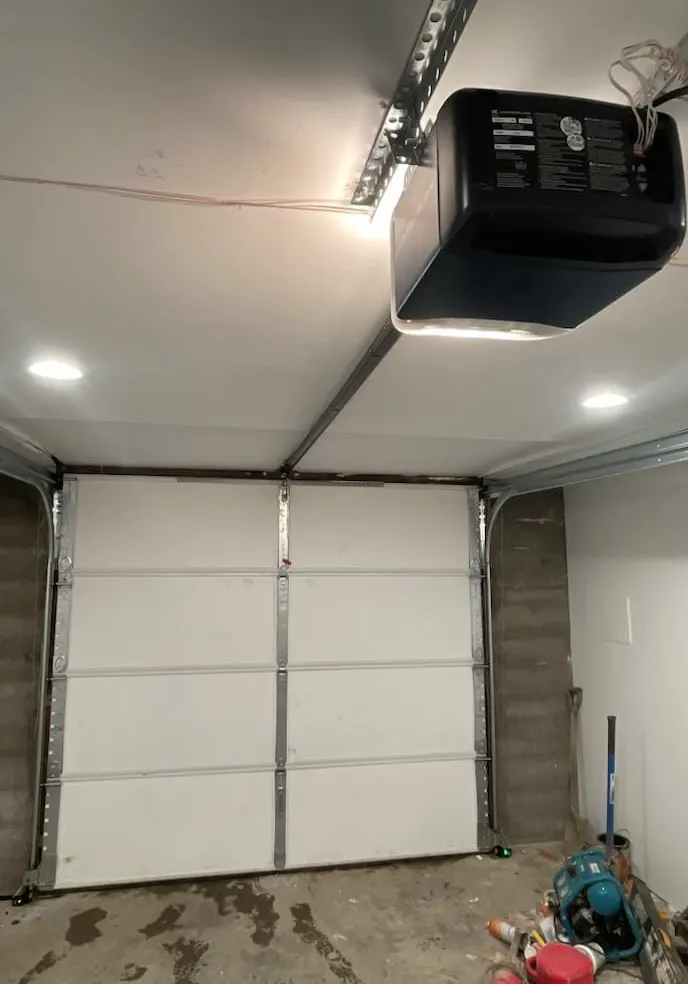
What a Technician Sees on This Call
A homeowner calls in a panic: the garage door is stuck halfway up, won't budge, and now the opener won't even respond. Nine times out of ten, the story is the same. The power blinked during a monsoon storm, or the opener started grinding, so they pulled the red emergency release cord to get the car out. The door came down fine the first time. But a spring was already weak or cracked, and without the opener holding tension, the next attempt to lift the door by hand revealed just how heavy an unsprung garage door really is. Some doors won't budge past a few inches. Others drop hard and fast the moment the cord is pulled, because the spring that was supposed to carry most of that weight is no longer doing its job.
What the Cord Is Actually For
The emergency release is the red handle hanging from a cord near the top of the door, connected to the trolley that rides along the opener's rail. Pulling it disconnects the door from the opener's carriage, letting you raise and lower the door by hand. It exists for two situations: a power outage when you need to get a car in or out, or an opener that's physically failing (stripped gear, dead motor, broken belt) and needs to be bypassed temporarily. That's it. It's a manual override, not a troubleshooting tool, and it assumes the door's springs and cables are in good working order.
When Pulling It Is the Right Move
- Power is out and you need the car out before you lose daylight or before a monsoon cell rolls in.
- The opener motor has clearly failed — it hums but doesn't move the door, or you hear a snap and then nothing.
- You need to close the door during a breaker or wiring issue and the opener isn't responding to the remote or wall button.
In all of these cases, pull the cord only when the door is fully closed or fully open, never halfway. A door caught mid-travel has the least support from the spring system and is the most likely to fall or jam when disconnected.
When Pulling It Makes Things Worse
The cord becomes dangerous the moment a spring, cable, or roller is already compromised. A torsion spring that's cracked or a cable that's frayed may still be holding the door up through tension — barely. Disconnect the opener in that state and the door loses its last bit of support. It can slam down hard enough to bend track, snap the remaining cable, or come off the rollers entirely. This is especially common after Tucson's hot stretches, when extreme dry heat cooks the lubricant out of springs and hinges and accelerates metal fatigue, so a spring that looks fine can be closer to failure than it appears.
Other signs it's the wrong moment to pull the cord:
- The door was already making grinding, popping, or snapping noises before you touched the release.
- One side of the door looks visibly lower or crooked — a sign of an unbalanced spring or broken cable.
- The door is heavy to lift by hand even with the opener still engaged, suggesting the spring is already doing less than its share of the work.
In any of these cases, leave the opener connected and call for repair instead. Pulling the cord won't fix the underlying problem — it just removes the one thing keeping a failing system from failing all at once.
Resetting It the Right Way
When you're ready to reconnect the opener, lower the door fully by hand first, then pull the cord toward the door to re-engage the trolley, or follow your opener's specific reconnect lever if it has one. Run the opener through one full cycle while standing clear, watching for smooth, even movement on both sides. If the door jerks, hesitates, or one side visibly lags, stop and don't use the opener again until the spring and cable system has been checked. A door that's out of balance will keep stressing the opener's drive gear every time it runs, on top of whatever heat and dust cycling has already done to it.
A Note for Cooler Nights and Dusty Days
As temperatures drop into the cooler desert nights this time of year, metal contracts and old lubricant that was already baked out by summer heat gets stiffer, so doors that were sluggish in October can start binding or jumping on the track now. Combine that with leftover monsoon dust in the rollers and tracks, and a compromised spring has even less margin before it fails.
When to Call Tucson Garage Door Repair
If you've had to use the emergency release more than once in a season, if the door feels unusually heavy, or if you notice gaps, fraying, or rust on the springs and cables, it's time for a professional look. Tucson Garage Door Repair handles spring replacement and track & roller repair as same-day service across Tucson, Oro Valley, Marana, Sahuarita, Vail, Catalina Foothills, Casas Adobes, and Green Valley. We'll check spring tension, cable condition, and opener alignment so the release cord stays what it's meant to be — a backup, not a last resort during a breakdown.
If your garage door isn't behaving the way it should, call Tucson Garage Door Repair today for fast, honest service anywhere in the Tucson area.